Prólogo
Counterpart, competitor, or systemic rival? Or perhaps, all three at once? The truth is that the People’s Republic of China has become an unavoidable factor in the international arena. Trade, climate change, resource exploitation, investments, networks – none of these issues can be seriously addressed without considering China’s growing role.
In a context marked by wars and geopolitical tensions, we must closely observe and, above all, learn from what is explicit and what is not in Chinese politics. This applies to Latin America and the world. The confrontation between two models of society is evident in various areas. The «shared destiny of the human community» will no longer be directed by the West. Shi Ming quotes Xi Jinping as saying so. Our author warns that China «may be dangerously approaching the high-tech level of the United States». Tim Rühlig cautions that, to enhance its normalization capacity, «China has carefully studied Western approaches and selectively modified these practices to serve its own state economy».
Regarding the economic sphere, Alicia Garcia Herrero asserts that «sustained growth has kept China’s labor costs low for an extended period and helped it remain competitive globally». This is one of the factors explaining the Chinese economic miracle and the achievement of lifting 800 million people out of poverty. The flip side is the repression of human rights, as noted by the author Alicia Hennig.
China poses a challenge to democracy and freedom. Its economic and technological achievements position it not only as a regional but a global power. It is evident that behind the soft politics and the irresistible offers of its colossal market lie geopolitical objectives. Behind export opportunities, there are risks that it is advisable to identify in a timely manner.
Aya Adachi emphasizes that «Latin American countries benefit from the expansion of markets for their raw materials. At the same time, they face competition from Chinese products, which can create pressure on local industries». Juan Pablo Cardenal, on the other hand, highlights that «commodity prices were sky-high, and Chinese demand strongly boosted the GDP of many countries». He concludes that «the new world emerging from the pandemic is the end of globalization as we knew it and the emergence of two ideologically and geopolitically opposed blocs».
The key components of soft power are culture, political values, and foreign policy. Author Vladimir Rouvinski warns that through these, «China seeks to recruit governments and peoples of Latin America to support its new global initiatives that aim at redesigning the architecture of the future world order». The flip side of soft power is the military ambitions of the Asian power. Author Meia Nouwens asserts that «the People’s Liberation Army is the armed wing of a political party rather than a country’s military». Regarding China’s power, «the structure of the reforms, and the types of capabilities that China has focused on building through reforms and procurement, point towards building a force that can achieve reunification by force if so required by China’s leadership».
Author Zsuzsa Anna Ferenczy analyzes the issue in the context of the aggression against Ukraine and concludes that «the strengthening friendship between Russia and China advocates for an order based on the will of the strongest». David Merkle wonders how a successful recalibration of policy toward China can be achieved. He concludes that «China under Xi Jinping has embarked on a course that increasingly portrays the West as an adversary. China seeks to counter universalist claims with its own values, ideas, and norms». This makes it essential to focus on one’s own resilience for any interaction with China.
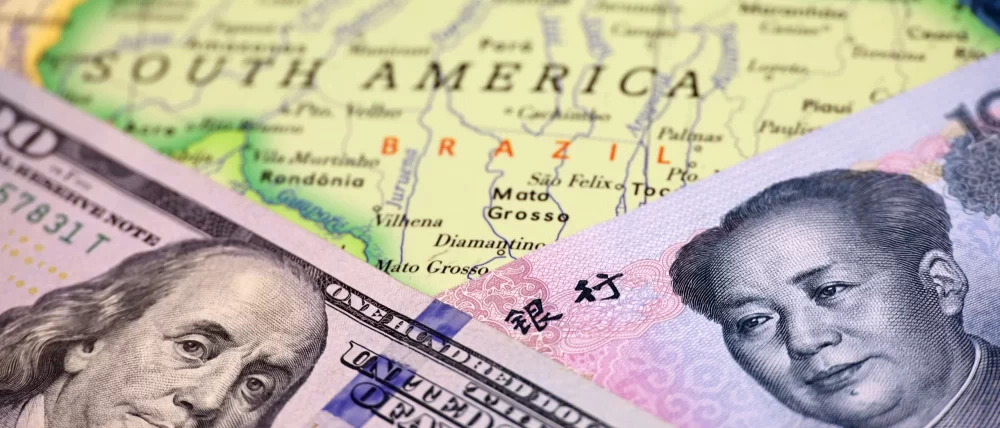
The scenario is complex, and the wars of recent years show how quickly the peace considered guaranteed for the last decades can be lost. The People’s Republic of China is undoubtedly an unavoidable player. On the one hand, it offers its colossal market, and on the other hand, it shows its teeth when it comes to Taiwan or access to limited but indispensable resources for Western economies. Latin America has in China a buyer for many of its products, but more importantly, an eager buyer of commodities interested in conditioning their marketing and imposing their rules of the game.
From Diálogo Político, we want to stimulate thoughtful reflection on this gigantic challenge that seems not always to be sufficiently recognized by authorities, political parties, or the public opinion in Latin America. It is not a time to believe naively in seemingly generous offers. On the contrary, it is necessary to read the fine print of contracts and agreements.
«The enthusiasm in Latin America resembles ours (in Eastern Europe) a decade ago», states Martin Hála in an exclusive interview with Diálogo Político. The Czech expert warns about the implications of free trade agreements with the communist power. The Chinese government is pursuing a project that expresses the intention to reorganize the world order.
The survival of democracy, of the rule-based order, of the unrestricted validity of human rights is at stake. To face this challenge, learning is essential. Understanding China well is the first step to engage effectively with it. We hope this special edition contributes to this learning process.
Sebastian Grundberger and Manfred Steffen
Keys to understanding china
Artículos

Martin Hála: «The economy in China is not independent of politics»